New safeguards approved for Illinois hospitals' adult guardianship cases
Published in Senior Living
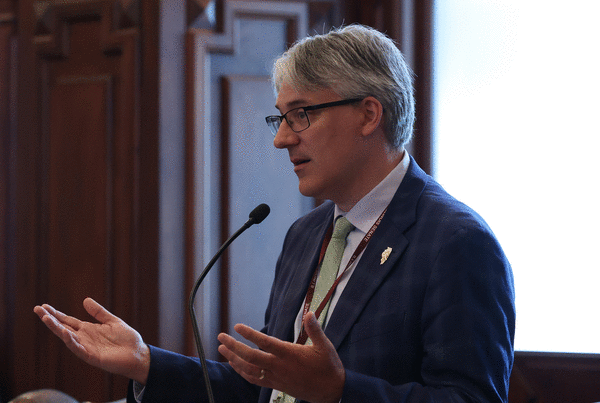
CHICAGO — A bill aimed at strengthening protections for vulnerable adults under guardianship gained approval from Illinois lawmakers six months after a Tribune investigation revealed troubling consequences of area hospitals’ use of guardianship.
If signed into law by Gov. JB Pritzker, the legislation will create a number of additional oversight mechanisms for hospitals and other parties that request guardianship for an adult with whom they have no personal relationship, as well as for private professional guardians.
Guardianship is a life-altering and often permanent legal process that strips disabled adults of control over their life decisions. Under the new legislation, institutions that petition for guardianship and recommend a private guardian will be required to provide information to the court describing their “efforts to contact the (person’s) nearest relatives.” They would also need to notify the county public guardian of the case.
The bill also encourages private professional guardians to meet with the allegedly disabled adult prior to being appointed to the case or as soon as is feasible. An earlier version of the bill had required that such guardians attest in court that they had met with and assessed the adult prior to their appointment.
The Tribune’s investigation last year found that area hospitals filed guardianship petitions on behalf of patients hundreds of times during an 18-month period. The reporting revealed that the hospitals’ use of guardianship often eased the way to discharge patients to subpar nursing homes and sometimes stripped family members of the ability to make decisions for their loved ones. Tribune reporters spoke with several family members or close friends of patients who said they were taken by surprise when a hospital filed for guardianship, recommending that someone else make decisions for their loved one.
While most of the patients placed under guardianship had limited financial assets and were represented by the Office of the State Guardian, the Tribune found that patients with financial assets like a home or savings were often placed under the care of the same private guardianship organization. In several instances, the Tribune found, the private guardian and its lawyers billed the former hospital patients for thousands of dollars in fees on top of hefty nursing home costs, quickly draining lifelong savings.
Other guardrails in the bill include naming an individual on the guardianship petition instead of an organization, requiring certification of all staff working in guardian roles at private guardianship organizations, and periodic background checks of those employees.
Private guardians will also be required to notify the court at least 60 days prior that they are planning to refer the disabled adult under their care to the state or county guardian, and to estimate as part of the budgeting process how much longer the disabled adult can afford their fees and services before their estate is depleted. They also need to notify the court if the disabled adult’s home would be required to be sold to pay for continued services within the next 36 months.
Two prior bills that aimed to address the steep costs charged by private professional guardians and their lawyers in guardianship cases initiated by hospitals, nursing homes and similar institutions faced staunch opposition because they barred private guardians from being appointed. The recent bill still allows for the appointment of private guardianship organizations in those cases.
Although the final version of the bill includes several compromises from the original language, Cook County Public Guardian Charles Golbert, who along with AARP Illinois helped champion the bill, said it still represents real progress in safeguarding the rights of vulnerable adults.
Golbert, whose staff oversees the cases of more than 600 adults under guardianship, said face-to-face meetings are standard practice in his office prior to appointment and are crucial to properly assessing the person’s needs. He said more than 20% of all cases in his office involve people under a limited guardianship that allows the person some control over their life. In the Tribune’s 18-month review, only seven of the hospital-initiated guardianships, or roughly 2%, were limited in nature.
“I think all guardians should be seeing and evaluating their people before they’re appointed,” Golbert said. “I think that’s key to preventing unnecessary guardianships and from preventing a full guardianship when the person might only need a limited or a temporary guardianship.
“But the bill still does a lot. I still support it.”
State Sen. Michael Halpin, a Rockford Democrat and one of the bill’s sponsors, said in a news release citing the Tribune’s investigation: “This kind of abuse taking place in Illinois is unacceptable. When our most vulnerable are put in the care of a stranger we have to guarantee that individual’s safety and financial security.”
In an emailed statement, AARP Illinois State Director Philippe Largent said the AARP worked with Halpin and another sponsor, Rep. Marti Deuter, in collaboration with “aging, hospital, and guardianship advocates to pass a meaningful measure that helps protect older adults, caregivers, and all Illinoisans” who are involved in private guardianships.
“This bill reflects a strong commitment to improving lives, strengthening accountability, and ensuring greater protections for vulnerable individuals across our state,” Largent said.
A spokesperson for Pritzker’s office said in a written statement that state agencies were “heavily involved in negotiations” around the bill and its passage. The spokesperson did not confirm whether the governor intends to sign the bill into law, stating “the Governor will carefully review everything that comes across his desk.”
©2026 Chicago Tribune. Visit chicagotribune.com. Distributed by Tribune Content Agency, LLC.




















Comments