From Hilary Duff to Olivia Dean: How female pop stars came to own their careers
Published in Entertainment News
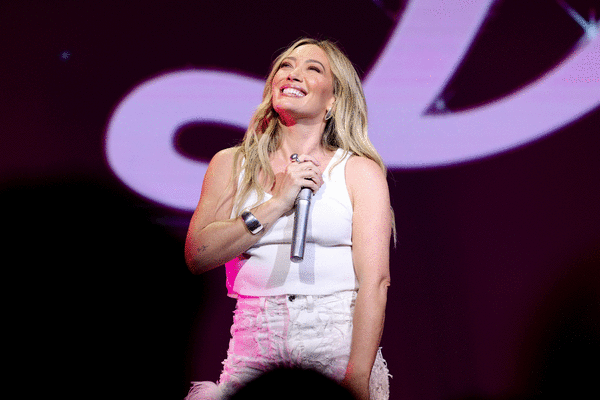
MINNEAPOLIS — Rora Wilde got hooked on Hilary Duff in the ‘00s by watching Disney Channel’s “Lizzie McGuire.” She couldn’t wait to go to the grocery store to find a magazine that featured the show’s star. Then, in 2005, the 11-year-old fan realized a dream — Hilary Duff in concert!
When Duff became pop’s unlikeliest comeback story of 2026, Wilde got to see her again live. She’s still an avid Duffender, staying up to date on the star via social media.
The landscape for women pop singers has changed dramatically in 20 years. Social media matters more than mainstream media. Streaming for free trumps CD sales.
Female pop artists not only get more respect, but they have more control over their careers and interact directly with fans who have seemingly insatiable appetites for new content.
U.K. singer Olivia Dean created a buzz with TikTok in her home country and now has 52 million followers on Spotify to go along with a Grammy for best new artist and a sold-out U.S. tour.
“[Back then] our insight was very curated, very approved,” said Wilde, 32, a Los Angeles music writer and singer. “Now we’re all in their business. Nothing is private anymore. If we don’t know a lot about [a female pop star], she’s irrelevant.”
Here’s at look at how female pop stars have taken control of their careers over the past two decades.
Artistic control
Then: Record labels ran the show. That usually meant men making decisions about songs, producers, image, videos and marketing. Pretty much everything. Remember the jailbait imagery of Britney Spears? The gimmick of Miley Cyrus/Hannah Montana? Pussycat Dolls performing in shopping malls?
Now: There’s been a decentralization of power in the record industry, said Evelyn McDonnell, Loyola Marymount University professor and editor of the two books on women in popular music.
“I think that has given all artists more control over their careers,” she said. “They have a more direct line to their fans because of streaming services and social media. If the record label doesn’t like a tune, [artists] just put it on the internet and see what fans think.”
McDonnell, who has studied music and gender, thinks today’s pop singers have learned from the pitfalls of Spears and the independent flex of Taylor Swift.
The current generation “have really strong feminist beliefs even though they don’t use that word,” she said. “There’s an awareness of the need for autonomy in artistry and ability to achieve it at a very successful level.”
From Swift to Olivia Rodrigo, today’s pop stars write their own songs, decide on their image and craft content for social media.
To paraphrase a Beyoncé song: “Women run the world.”
Media
Then: Commercial radio, print media and TV, including MTV, were critical gatekeepers. An artist’s goals were to get a top 10 song, land a high-profile newspaper write-up and secure high rotation on MTV. New female pop stars might get featured in Tiger Beat and maybe People magazine if their career took off.
Now: Artists control messaging via their own social media accounts. They share what they want to share and that seems to be not only music but beauty tips and images of their pets and family.
Fans are more likely to discover new artists on YouTube, TikTok and streaming services than on commercial radio. That means both artists and music lovers have more options.
“Artists are finding a lot bigger audiences at younger ages than their predecessors did, for sure, I think because of social media,” said Melissa Ruggieri, national music writer for USA Today.
Some industry experts question if the new world order is for the better.
“With social media, there is no filter,” said semiretired publicist Liz Rosenberg, who tried to smooth over many a controversy in more than 30 years working with Madonna.
Rosenberg, who still represents Cher, also thinks some stars post too much.”
Many of today’s female pop stars disagree. Selena Gomez has 404 million Instagram followers, Ariana Grande has 360 million and Duff, an old-schooler making headway in the new ecosystem, counts 28 million. All post regularly.
At least one young pop star understands the potential overkill of social media. Olivia Dean, 27, removed her social media apps after she won the best new artist Grammy and the BRIT Awards for best album and artist in February.
“Even though the love has been overwhelming, even that is not healthy sometimes,” Dean told Elle magazine. “I don’t think you’re supposed to know everyone’s opinion about you. And I’ve decided I want to live in sweet ignorance.”
Fan relationship
Then: There were carefully orchestrated campaigns, whether via fan clubs or sound-bite driven interviews on radio, MTV or network television. Rarely was there a big-reveal interview.
Now: “It is so much harder to stand out and fans expect everything,” said critic Ruggieri, who has been on the pop beat for more than 25 years. “Look at the Taylor [Swift] wedding. ‘Where are the photos?’ ‘Why the secrecy?’ They [fans] feel they are owed a backstage pass to everything because the artists have trained them that way.”
Moreover, fans have the power to post. It gives them a certain amount of clout that they’ve never had before.
Wilde credits a 2021 fan-generated meme for re-igniting interest in Duff. It was a recycled clip of her 2007 performance of “With Love” from “The Today Show” with distinctive if uninspired dancing.
“All of sudden that song comes back [via TikTok] and everyone knows the dance,” Wilde said. “Hilary embraced it. Now in her show today when she plays that song, she invites fans to do the dance onstage with her.”
“Never underestimate the power of teenage girl love,” McDonnell, the professor, said. “They’ll stick with you forever if you show your loyalty to them.”
Concerts
Then: Unless an artist was launched from a TV show like Duff or Cyrus, she was expected to work her way up the ladder — from coffeehouses to clubs to maybe opening act to theaters and hopefully arenas. It was called paying dues and learning your craft like Swift did moving from Nashville showcase clubs to opening slots on tours with Brad Paisley and Rascal Flatts.
Now: It’s practically instant stardom.
“You’re seeing so many of these young acts — and both Olivias are examples of this — of being popular online whether it was Tik Tok or YouTube and they’re skipping all the steps. They’re going from that [viral success] to playing arenas or stadiums,” Ruggieri said.
“I’m wondering if these young people are not learning how to be as good a performer because they’re not going through the ladder. Maybe that’s not a great thing for career longevity. All you know is being adored your whole life.”
Dean has become an arena headliner on the strength of one hit song, “Man I Need,” though she did open for Sabrina Carpenter’s tour last year. Despite the demand, Rodrigo was afraid to launch her career in arenas after her 2021 instant blockbuster debut album “Sour,” so she opted for midsize venues before graduating to arenas.
Concerts can separate the true talents from the manufactured and manicured ones.
Wilde, who is a fan of current pop stars Tate McRae, Grande and Carpenter, was verklempt over old-fave Duff’s energetic concert this year.
“I was instantly covered in girlypop goosebumps,” Wilde wrote in her review in Hit Parader, a music magazine.
Respect
Then: Pop stardom was mostly ephemeral. In the '00s, there were lots of female one-hit wonders like Blu Cantrell, Vanessa Carlton, Dream and Samantha Mumba. Music experts didn’t take them seriously. It became a game of who’s the next instant success story by the star-making machinery. Some ‘00s stars like Pink and Duff have lasted.
Now: Women pop stars are commanding more respect. Maybe the tide changed when Swift bought back her masters from her original record label in 2025 and rerecorded her songs, Rosenberg suggested.
McDonnell feels you have to respect successful artists who have mastered the game. She said it’s easier to respect Swift and Rodrigo than Spears because “they’re coming out based on their talents without being encouraged to appear sexualized.”
Times have simply changed, insists old-schooler Rosenberg.
“In my heyday, female artists had a lot more to prove than a male artist to be believed to be considered authentic,” she said. “I don’t think that’s the case now. They’re being taken more seriously and there’s a lot more of them.”
©2026 The Minnesota Star Tribune. Visit startribune.com. Distributed by Tribune Content Agency, LLC






Comments