Peru on edge as exit polls show no clear presidential winner
Published in News & Features
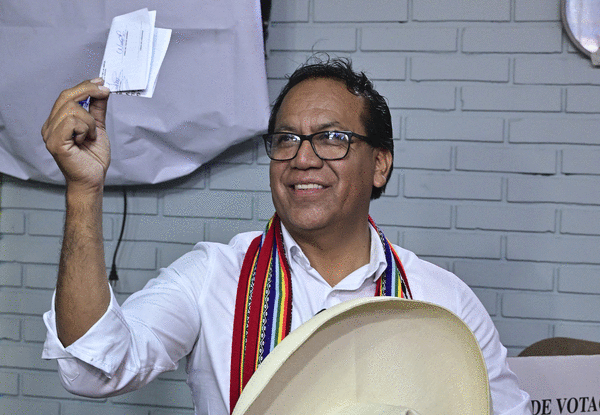
Peruvians were on edge Sunday as exit polls offered little clarity on which candidate would win the bitterly contested runoff to become the country’s next president.
An exit poll by Ipsos showed conservative Keiko Fujimori with 50.7% of the vote while leftist Roberto Sánchez had 49.3%. Another poll by firm Datum projected Fujimori at 50.53% and Sánchez at 49.47%. Both polls had a margin of error of three points.
Ipsos and Datum will release quick counts based on a sample of voting stations across Peru later this evening, but final official results aren’t expected until mid-July.
The two candidates have starkly different ideas on how to lead the politically turbulent nation with an economy that’s managed to outperform peers despite cycling through four presidents in the last five years. The winner will succeed interim President José María Balcázar on July 28 for a five-year term.
Fujimori is one of Peru’s most powerful politicians, and her Popular Force party has wielded significant influence in Congress even as she’s been runner-up for the presidency in three consecutive elections from 2011 to 2021. The legacy of her father, former leader Alberto Fujimori who was convicted over human rights violations and corruption, has weighed on her previous runs.
A conservative, she has promised tough-on-crime policies and is viewed positively among investors who favor her pro-market policies. Her win would add Peru to the wave of Latin American countries shifting to the right, while Sánchez would steer the country in the opposite direction.
Fujimori has promised to deport undocumented immigrants who commit crimes, give the armed forces control of the border and replicate the high-security mega-prison El Salvador built under President Nayib Bukele. She has also pledged to double annual economic growth from the current 3% to 6%, slash red tape and introduce zero taxes for small businesses to boost formalization in an economy where 70% remains informal.
A Sánchez surge is likely to rattle investors, in part because he has pitched himself as the heir to hard-left former President Pedro Castillo, who has been in prison since attempting a power grab in 2022. Sánchez, who was Castillo’s foreign trade and tourism minister, has pledged to pardon him and follow through on his plans to redraft Peru’s market-friendly constitution, arguing that it limits the state’s ability to guide the economy development and manage strategic resources.
He’s earned support in Peru’s poorer Andean regions thanks to his promises to increase the minimum wage, bolster family farming over agribusiness and double public spending in rural areas. But as was the case for Castillo, Sánchez would struggle to enact significant reforms because he would lack majorities in the new fragmented Congress.
©2026 Bloomberg L.P. Visit bloomberg.com. Distributed by Tribune Content Agency, LLC.






Comments